New Drama Surrounding WordPress Owner Company Automattic


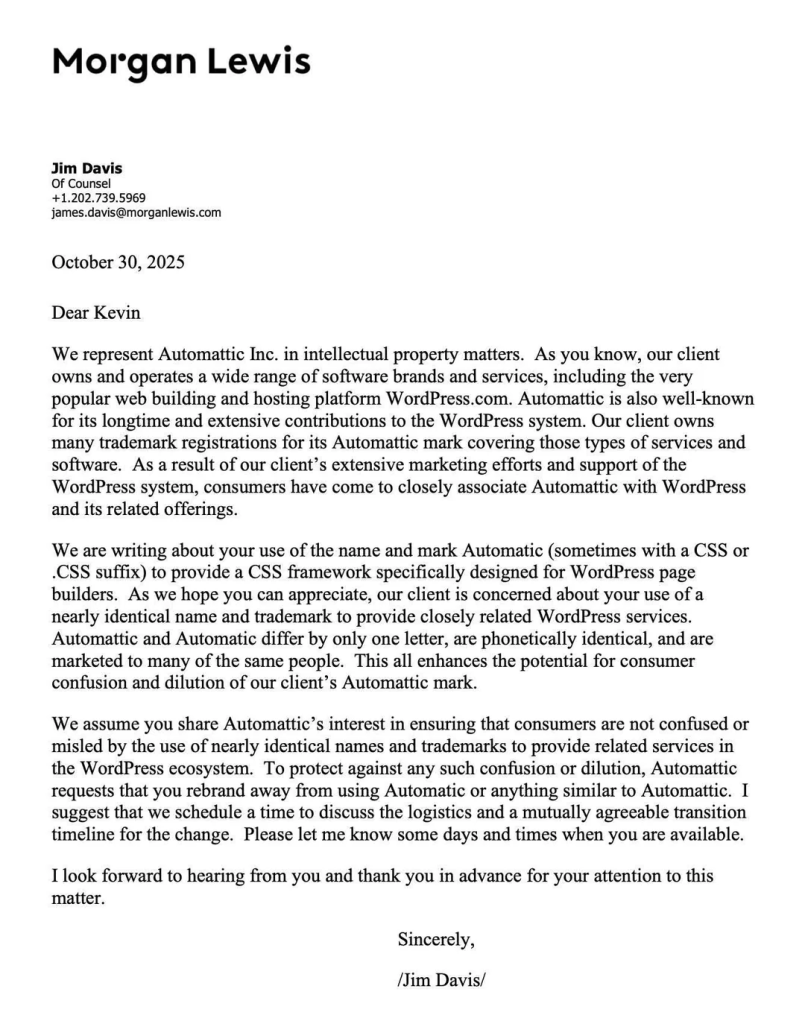
On October 30, 2025, Automattic (founded by WordPress co-founder Matt Mullenweg) filed a formal complaint against developer Kevin Geary. The issue revolved around Geary’s use of “Automatic” in the name of his CSS framework aimed at the WordPress ecosystem. Automattic’s legal team argued that the name Automatic.css could create confusion with the Automattic brand.
Why Automattic’s complaint was surprising
The complaint surprised many in the WordPress community for several reasons. Earlier in the summer, Mullenweg had a friendly chat with Geary on Twitter, asking him to clarify that Automatic.css wasn’t affiliated with Automattic. They exchanged a few kind words, and Geary made the necessary adjustments.
Their exchange was brief and friendly:
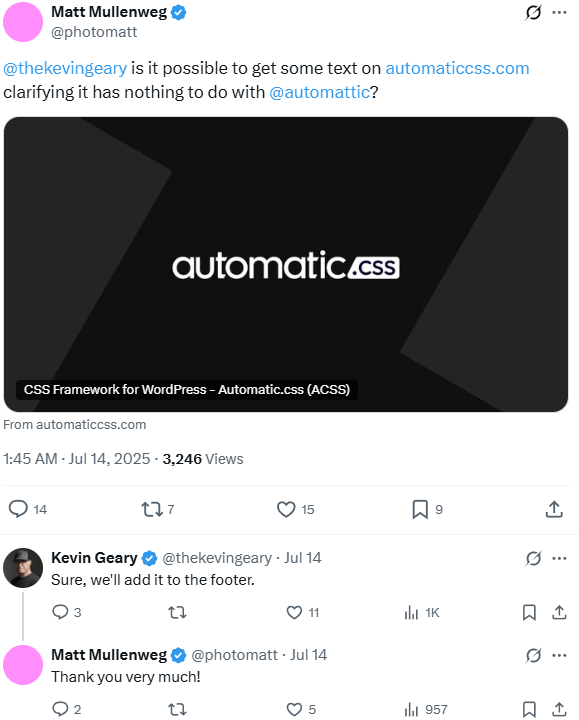
Everyone thought that was the end of the story. So, when the legal letter dropped months later, it left people scratching their heads. Geary had already shown goodwill, and it seemed Automattic had either changed course or was secretly planning a more aggressive strategy all along. Many felt the leap from casual conversation to legal action was totally unexpected, especially since Mullenweg had indicated that a simple disclaimer would do.



Who is Kevin Geary?
Kevin Geary has been a notable WordPress developer since 2005. He’s currently focused on the EtchWP visual builder (in alpha) and developing his Automatic CSS (ACSS) framework, a tool designed to simplify and standardize website design while seamlessly integrating with popular builders like Bricks, Gutenberg, and Oxygen.
Geary isn’t afraid to voice his thoughts about WordPress, especially regarding the Gutenberg editor. He’s pointed out issues with its interface and workflow, stating that, without third-party tools, Gutenberg often misses the mark for pro developers. Still, he supports the WordPress ecosystem and recognizes its potential, even while acknowledging its flaws.
Despite his critiques, Geary actively supports WordPress and consistently highlights the ecosystem’s importance and potential while acknowledging its weaknesses.
What was in that Automattic letter
Geary shared a copy of the letter on Twitter. The legal team argued that Automatic.css sounds too much like Automattic and could mislead WordPress users.
Legal context
Trademark law, whether it’s in the U.S., EU, or anywhere else, has one core rule: you can’t own a common word that simply describes what your product does. These terms are called generic or descriptive, and judges usually don’t give exclusive rights over them.
Sure, a company might get a trademark on a descriptive name, but that protection usually only covers a specific combo or a unique logo. Not the word itself.
Take Automattic, for example. They’ve got the rights to “Automattic,” their logos, and their work in SaaS, hosting, and content publishing. But they don’t own “automatic.” You’ll find other businesses using similar names, like Automatticc in auto-repair.
Legally speaking, the big question is whether an average consumer might mix one product up with another. This is known as the “likelihood of confusion.”
Mullenweg’s reaction and Geary’s response
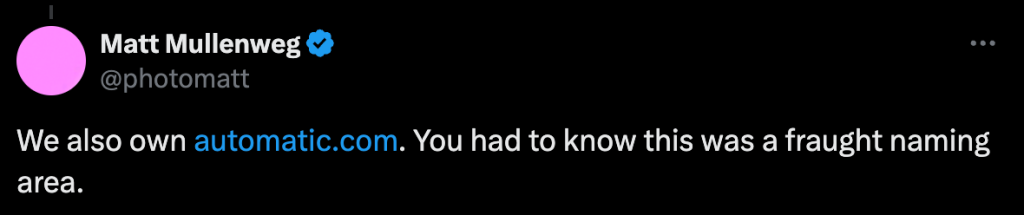
Mullenweg responded on Twitter, noting that he “owns the automatic.com domain,” suggesting that the naming space was already occupied. Bold move!
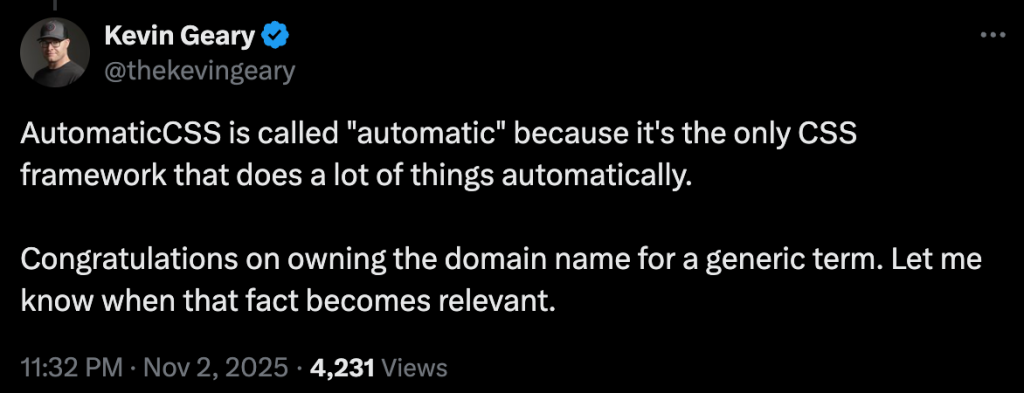
Geary, obviously, pushed back on this point:
WordPress community reaction
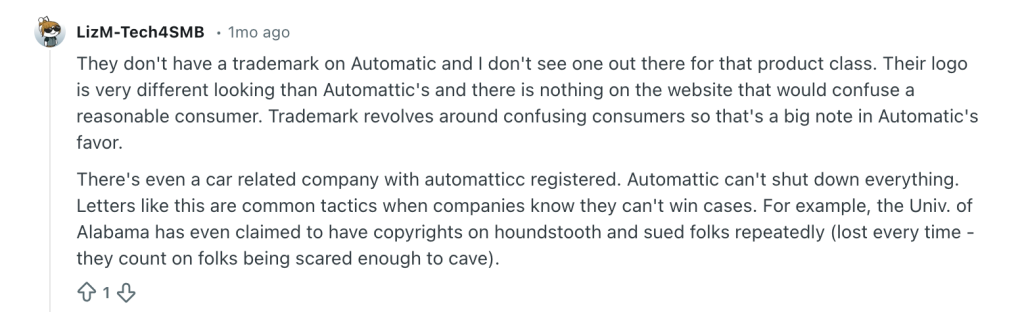
After the letters and related correspondence became public, the conversation rapidly shifted to Reddit, where reactions were even stronger than on WordPress Twitter. The consensus among commenters was that Automattic was trying to protect a word that shouldn’t be monopolized.
One user put it bluntly:
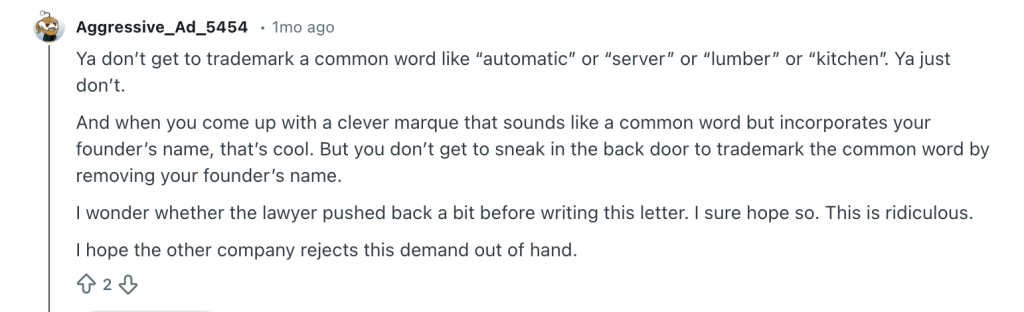
He also noted that the Automattic brand itself plays on words derived from the founder’s surname, making the attempt to “claim” the root word from a third-party developer seem unethical.
Other participants emphasized a key legal point: Automattic does not hold a trademark for the word “Automatic,” especially not in the relevant product category.
As one commenter pointed out:
Some users drew parallels to other companies that have tried to stretch the limits of intellectual property enforcement (cough-cough Figma cough):

And there were more emotional interpretations of Mullenweg’s actions:

What’s next?
A month has passed since the letter became public, and Geary has yet to announce plans for changing the product’s name.
The conflict will likely die down on its own, but not without repercussions. Automattic & Mullenweg have already faced a wave of criticism for what many perceive as excessive legal pressure, while Geary’s reputation has strengthened, with many viewing him as a defender of the broader WordPress ecosystem.
Overall, most of the WordPress community would prefer the issue to fade quickly. Developers want to concentrate on improving WordPress, not wading through another legal dispute.