Can you host my website and email separately?


When you run an online business, the question of hosting a website and email separately often comes up.
For example, a company might switch to a new hosting provider for its website but choose not to move its email. It sounds overwhelming, so why on Earth would anyone do that? Well, if you’re not hosting with SpaceLama, email issues may arise, showing that the current provider’s email service isn’t working well. In these cases, separating website and email hosting makes perfect sense.
Yes, you can host your website & email separately
Yes, you can host your website and email separately, and many businesses do this today. For instance, many companies use Google Workspace for email while hosting their websites on different platforms.
This separation is practical because web hosting and email services do different jobs. They use different technologies and have unique needs for stability, security, and growth.
How website hosting and email hosting actually work
In reality, web hosting and email hosting are two very different layers of infrastructure that have often been bundled together for convenience.
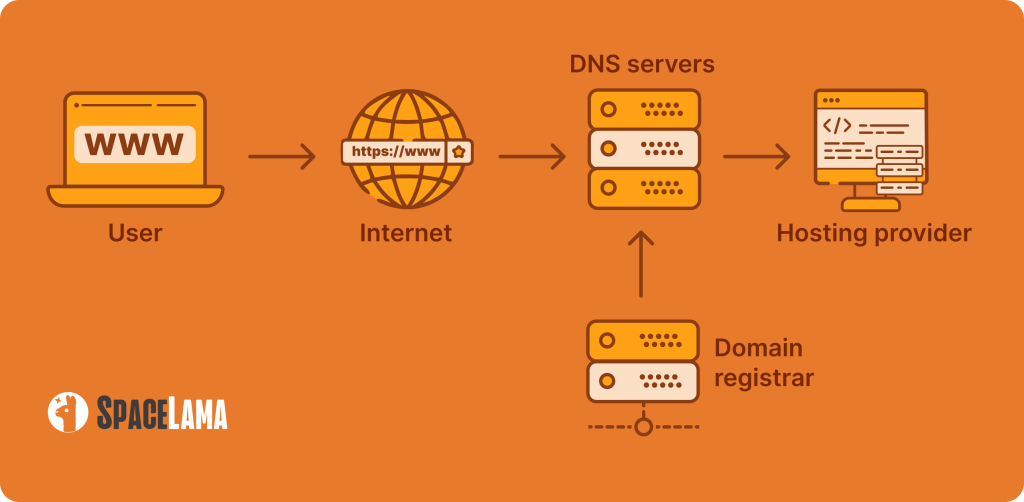
Web hosting is responsible for one core task: delivering website content to users. This includes storing files or application code, handling HTTP requests, working with databases, caching content, using a CDN, and running PHP, Node, or Python processes. Even a simple website has clear priorities: fast page load times, stability during busy periods, proper application functioning, and the ability to update or move without issues. If a website goes down, it’s inconvenient. But it doesn’t usually bring business operations to an immediate stop.
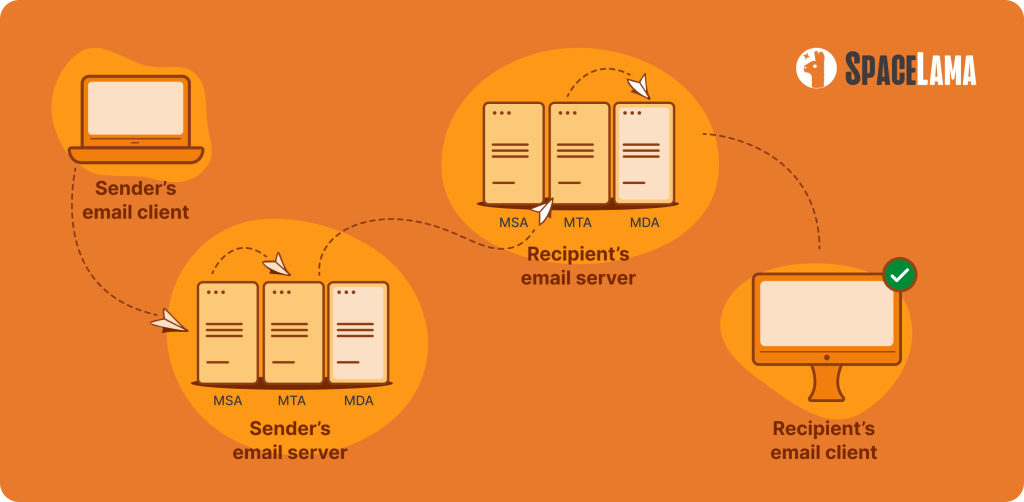
Email hosting, on the other hand, addresses a different challenge: reliably delivering messages between mail servers worldwide. In this case, the focus isn’t on web pages or requests. Instead, it’s about maintaining a good IP reputation, setting up DNS records correctly, filtering out spam, managing delivery queues, implementing retry logic, ensuring encryption, and meeting the standards of major providers like Gmail and Outlook. Email needs to work consistently and predictably because a lost message is often hard to recover or resend.
This separation is also evident at the DNS level. Websites rely on A/AAAA and CNAME records, while email uses MX, SPF, DKIM, and DMARC records.
So, if one layer fails, the other typically remains unaffected.However, in all-in-one hosting setups, both services often run on the same infrastructure, which increases the chances that one issue could impact everything.
Why hosting providers often bundle website and email
Bundling website and email into a single plan is mainly a business decision by hosting providers. For many customers, especially in the early stages, this approach seems logical. It’s just one account, one control panel, and minimal setup.
And, from the provider’s viewpoint, this model solves several challenges.
First, it simplifies onboarding: a user registers a domain and chooses a plan, getting a website, email, DNS, and SSL all in one place without needing to connect different services.
Second, it reduces support workload, as there are fewer questions about MX records, SPF settings, and email routing.
Third, it improves customer retention: when a website and email are both tied to one provider, switching becomes complex, making it easier to stay put.
For small projects with low email volume and no immediate scaling needs, the all-in-one model saves time and lowers barriers to entry. However, this convenience relies on simplifications that often become apparent later. Email services in these plans are rarely optimized for deliverability, IP reputation is shared across many customers, and detailed configuration options are limited to what the provider can support rather than what a specific project might need.
Reasons to host your website and email separately
Reliability and fault tolerance
When a website and email share the same infrastructure, a single issue can affect both, like a server update, disk failure, an IP block, or a data center outage. If email goes down with the website, the impact is often much greater. Separating them helps isolate risks: you can restart, migrate, or test the website without risking losing emails or critical notifications.
Scalability
Websites and email systems scale in very different ways. A website may need more resources during advertising campaigns or traffic spikes, while email focuses on stability. When both are tied to the same hosting plan, scaling usually means upgrading the entire plan, even if only one part needs it.
Email security and reputation
Email deliverability relies heavily on server and IP reputation. In shared environments, this reputation is also shared: spam activity from others can affect whether your emails reach the inbox or end up in spam. Dedicated email services invest in spam filtering, reputation monitoring, and compliance, while bundled email often isn’t prioritized.
Ease of migrations and provider switching
When a website and email are closely linked under one provider, changing anything leads to issues. Moving the website might disrupt email, and updating DNS settings can introduce downtime. Separating them offers flexibility: you can move the website, test infrastructure changes, or switch providers without affecting email, which continues to operate independently.
When keeping them together actually makes sense
Split hosting isn’t necessary for every project, especially if the website is small. This includes personal sites, simple business pages, blogs without active sales, and local service websites with low email traffic. In these cases, email usage is occasional, volumes are low, and the need for reliable delivery is basic.
The second scenario involves temporary or experimental projects. Campaign landing pages, MVPs, test products, and short-term promotional sites often have a limited lifespan. Setting up a separate email service, tracking domain reputation, and managing additional infrastructure makes sense only if a project is meant to last long-term. For short-lived initiatives, an all-in-one plan saves time and simplifies setup.
Lastly, resource constraints, both technical and organizational, play a role. Split hosting requires a basic understanding of DNS, decision-making for configurations, and ongoing maintenance. If no one is available to manage these tasks, and even minor changes create challenges or need outside help, the simplicity of an all-in-one solution may be a more practical choice than a cleaner but poorly maintained setup.
So, should you host your website and email separately?
The decision to separate website and email hosting isn’t a simple “yes” or “no”. It’s an infrastructure-level choice that depends on the project’s goals, scale, and tolerance for risk.
If a website is a core growth driver, changes frequently, scales dynamically, or runs in a cloud-based environment (and email is used for sales, support, financial notifications, and account access), then separation is almost always justified. In this setup, system coupling is reduced: the website can evolve, be rebuilt, or migrated without risking disruption to the communication channel that directly affects revenue and operations.
If a project is small, stable, and generates little email traffic, the benefits of separation may be limited. In these cases, manageability matters more than architectural purity. The infrastructure should be easy to understand, simple to maintain, and not require constant oversight to function reliably.
Separating website and email hosting is a question of appropriateness. For some projects, it adds resilience, flexibility, and peace of mind. For others, it simply introduces unnecessary complexity into a setup that already works. When infrastructure decisions are made consciously, the choice becomes clear: separate components where it reduces risk and increases control, and keep them together where separation adds little practical value.
Ultimately, it’s your choice and we’re here for it!
Here, at SpaceLama, we don’t lecture you on how to run your business. We understand that you might prefer to separate your website hosting from your email hosting, and that’s totally fine with us. Whatever your hosting and domain needs are, SpaceLama is here to support you every. single. time. With SpaceLama’s 24/7 dedicated hosting support, you can rest easy knowing we’re always here to assist you, no matter the hour. Our reliable hosting solutions ensure that your website stays up and running smoothly, so you can focus on what truly matters – growing your business.