Best web personalization tools for 2026

In recent years, the impact of web personalization has surged. According to this McKinsey report, companies leveraging personalization can grow their revenue up to 40% faster than their competitors and boost conversion rates by 10–20%.
Demand for personalization is rising among users too. Consumers are used to tailored Netflix catalogs, Amazon’s recommendation system, and TikTok’s adaptive feed. They’ve come to expect that same level of precision on any website, be it an online store or a B2B platform.
Find out how modern web personalization works, the key criteria for selecting a platform, and which solutions are worth your attention in 2026.
How to choose a web personalization tool
Alignment with business goals
McKinsey finds that companies implementing personalization throughout their customer journey can generate up to 40% more revenue from it. If your goal is to boost conversions on product pages, choose a tool that dynamically modifies page elements based on user behavior. For enhancing retention or increasing average order value, prioritize recommendation engines and segmentation based on past actions. Challenges often arise when a tool is adopted without clear KPIs.
Scalability
Many companies start with lightweight solutions but soon hit bottlenecks: inadequate segmentation capabilities, weak analytics, or an inability to manage real-time personalization. For brands experiencing high traffic or complex product logic, these limitations can be significant.
According to Contentful’s blog (one day we’ll get as big as them, you’ll see!), 98% of e-commerce retailers using personalization reported an increase in average order value, but nearly half found their initial tools couldn’t keep pace with data volume or rapid changes.
Tech stack
Modern platforms increasingly utilize machine learning to deliver product, content, or offer recommendations based on thousands of signals, from traffic sources to multi-week behavior patterns.
Integrability
If a company uses a CRM, CDP, or analytics system, the personalization tool must integrate seamlessly. McKinsey refers to this as a “single customer view,” enabling personalized on-site content along with a consistent experience across all touchpoints, be it websites, emails, mobile apps or sketchy banner ads.
Ease of use
A common scenario is when companies invest in powerful platforms but marketers struggle to leverage them fully. Complex interfaces, the need for developer involvement in every campaign, and a lack of templates can hinder effectiveness. As a result, expensive software may end up being a “feature-packed box that no one uses.” This is why focusing on user-friendliness is essential.
Main use cases for web personalization
Personalization in e-commerce
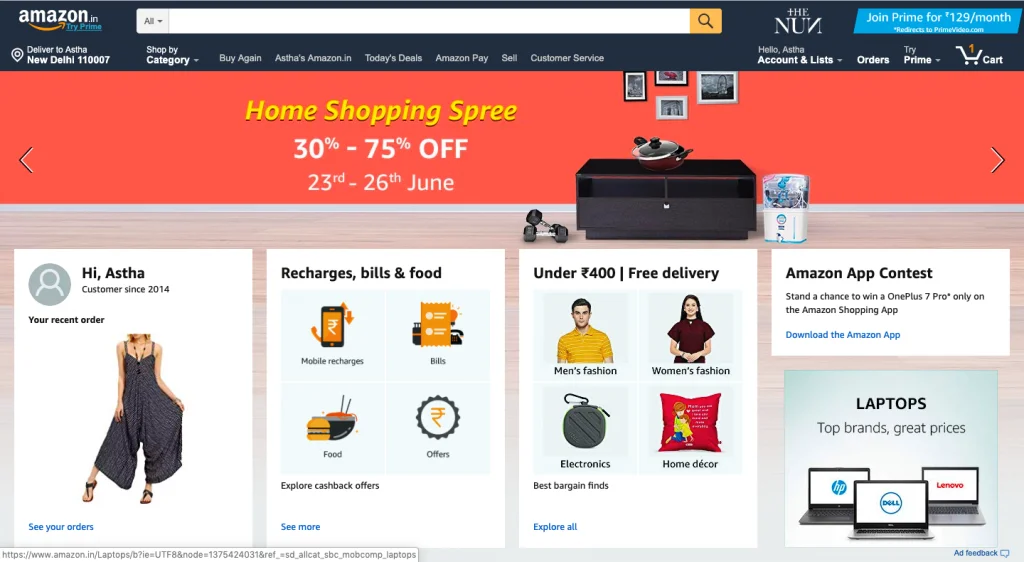
Back in the early 2010s, Amazon showcased that recommendation algorithms could drive up to 35% of its revenue. This landmark achievement influenced the entire industry. Today, the average online retailer leverages at least four personalized touchpoints: product detail pages, the homepage, in-cart recommendations, and those “Recently Viewed” sections.
Personalization for content platforms and media

The main use case is simply customizing article feeds to align with reader interests. For instance, The New York Times developed its own article-ranking and preview-personalization system, which boosted both time spent on the site and return visits. Many content platforms have found that real-time topic personalization enhances content consumption depth by 20–30%. Honestly, we believe the impact is way greater. If you’re a media company, personalization is everything these days. That – and a good, extremely reliable hosting provider.
Personalization for SaaS/B2B products

In SaaS and B2B products, personalization accelerates user activation and transforms new users into paying customers. Leaders like HubSpot and Intercom depend on personalized onboarding flows that adapt the interface based on the user’s role, company size, industry, and selected features.
According to Salesforce, over 80% of customers (both B2C and B2B) believe that the quality of their experience with a company is as important as the product or service itself. Personalization plays a key role in enhancing this experience, making it smoother and more welcoming for the customer. Plus, we’ve found that a great gift basket can be a game changer.
First-visit personalization
Another important area is first-visit personalization, where the system tailors the experience based on factors like traffic source, time of day, device type, or location. For instance, the European department store chain John Lewis boosted conversions by 7% by showcasing different product assortments based on the region.
Or, think about those hotel booking services that personalize offers according to the time of visit. When users try to book same-day stays later in the evening, the algorithm prioritizes “instant booking” options.
Best web personalization tools for 2026
Discover SpaceLama’s top picks for web personalization tools for 2026 that elevate user experiences, drive conversions, and enhance overall site performance.
OptiMonk

OptiMonk is a web personalization tool that operates seamlessly on existing websites, enabling brands to manage user experiences in real time. Its architecture revolves around segmentation, event triggers, and dynamic content that adapts to the visit context, such as traffic source, device type, behavioral patterns, previous actions, and abandonment probability.
One of OptiMonk’s standout features is its focus on first-visit personalization. According to the platform, customizing messages for first-time visits can boost the likelihood of purchase by 10–25%.

OptiMonk features
- Dynamic banners and page elements. OptiMonk empowers marketers to modify headlines, CTAs, color accents, product lists, benefit blocks, and promo codes directly on the website. No coding is required. In OptiMonk’s visual interface, any page element can be selected and customized with specific display rules.
- Next-generation exit-intent technologies. This tool utilizes multiple abandonment-detection models, including cursor-direction changes, sudden movement acceleration, tab-switching behavior, and declines in user activity, to anticipate when users might leave.
- Personalized display logic. OptiMonk allows each scenario to be linked to detailed conditions, such as the number of pages viewed, items in the cart, returning versus new visitors, UTM-based traffic, and predicted abandonment probability.
- Intelligent AOV-growth scenarios. The “Smart Product Recommendations” feature analyzes visit context (including category, price level, previously viewed items, and behavior of similar users) to display personalized blocks like “Complete the order” or “Popular in this category.”

- A/B and multi-step testing. OptiMonk enables you to compare different audience segments, test scenario sequences, and measure the impact of individual triggers. For instance, marketers can determine whether an upfront discount is more effective than adding a gift when a product enters the cart.
- Developer-free integrations. The platform seamlessly integrates with systems like Shopify, WooCommerce, BigCommerce, Klaviyo, Mailchimp, HubSpot, and more. Segmentation data can be directly passed into email platforms, enabling further automation.

- Multi-step pop-up funnels. The “Multi-Step Pop-Ups” feature allows for mobile-friendly mini-funnels that first gather user preferences, followed by email addresses, and then present a personalized offer. According to OptiMonk’s case studies, these funnels can boost subscription conversions by 3–5 times compared to traditional single-step forms.
Dynamic Yield

This might surprise you, but MasterCard owns Dynamic Yield! It represents MasterCard’s unexpected entry into digital marketing. Dynamic Yield is an enterprise-grade personalization platform tailored for companies with high traffic, complex segmentation needs, and stringent performance requirements. Unlike visual builders like OptiMonk or Nosto, Dynamic Yield leverages an AI engine that continually optimizes content impressions, recommendations, banners, menus, promotional blocks, and product ordering.
Dynamic Yield features

- Real-time personalization across the entire site. Dynamic Yield dynamically modifies interface elements (from the homepage to category listings and the shopping cart) based on user behavior, location, and purchase history. The platform analyzes visitor actions in milliseconds, generating the most relevant scenarios at the moment of interaction, such as product card ordering, banners, CTAs, themed collections, or low-stock alerts.
- AI models for catalog optimization and product recommendations. Dynamic Yield employs machine learning algorithms to estimate the purchase probability of each product. Based on these predictions, the “personalization score” reorders product cards, prioritizing items with a higher likelihood of conversion. The platform supports over 15 recommendation types, including “Similar Items,” “Frequently Bought Together,” “Trending in Category,” “Personalized New Arrivals,” and “Recently Viewed.” Recommendation blocks can be tailored to specific segments, showcasing general trending items to new visitors while presenting personalized selections to returning users.
- Flexible, high-granular audience segmentation. The platform creates segments using more than 150 signals, including purchase frequency, average order value, interest categories, traffic source, churn probability, behavioral patterns of similar users, regional weather, device type, and geographic attributes.

- Personalization of content, banners, and promotional messages. Personalization of content, banners, and promotional messages. Any page element can be selected in the interface and assigned custom display rules. For example, users in colder climates can be shown winter assortments, visitors from Google Ads can see promotions tied to specific UTM parameters, and loyal customers can receive tailored bonuses.
- A/B/n testing, automatic optimization, and multivariate experiments. The platform supports A/B/n tests, multivariate experiments, end-to-end personalization journey testing, and automated optimization (AI shifts traffic toward the best-performing variant). Marketers can test hypotheses on specific user segments (for example, new visitors, VIP customers, or users with a high likelihood of returns).
- Predictive targeting and propensity models. Dynamic Yield predicts the probability of purchase, bounce, repeat purchase, subscription, or churn. These insights enable intelligent scenarios. Users at high churn risk can be shown retention-focused offers, while users with high purchase propensity can receive premium upsell recommendations.
- Omnichannel personalization (email, push notifications, mobile apps, drive-thru). Dynamic Yield extends personalization beyond the website into email flows, push notifications, mobile apps, and even drive-thru menu boards personalization, famously used in McDonald’s.

- Enterprise-level integrations and API-first architecture. The platform integrates with Salesforce, SAP, Shopify Plus, Magento, Bloomreach, commercetools, Braze, Klaviyo, and any external system via API. This extensive integration capability makes Dynamic Yield ideal for large global organizations that require alignment between ERP, CRM, and custom ML pipelines.
VWO Personalize

https://vwo.com/personalization
VWO Personalize is a powerful personalization and experimentation platform tailored for companies aiming to adopt a systematic, measurable, and hypothesis-driven approach to user experience. It’s one of the more popular personalization tools out there.
Unlike tools that focus solely on delivering personalized content, VWO structures the entire process around experimentation, including A/B testing, multivariate experiments, behavioral analysis, and continuous iteration.
Key features of VWO Personalize

- Dynamic personalization of page elements. VWO allows you to customize headlines, descriptions, images, CTAs, benefit blocks, review sections, product pages, and other interface components directly in the visual editor. You can define custom display rules for each variant based on traffic source, country, UTM parameters, visit frequency, device type, page depth, or behavioral signals.
- Real-time personalization. The system collects data on user behavior during the current session and adapts the interface accordingly. This includes adjusting layouts, displaying personalized banners, showcasing relevant products and recommendations, and modifying navigation paths.
- Powerful experimentation engine. VWO features a robust experimentation engine that encompasses A/B testing, split-URL testing, multi-armed bandit algorithms (which automatically direct traffic toward winning variants) and multi-page experiments.
- Behavior-based segmentation. VWO supports advanced segmentation based on visit frequency, time on site, viewed products, user events (like scrolls and clicks), interaction depth, geography, device type, campaign origin, previous conversions, referrer, and UTM history.
- Behavioral triggers and personalized journeys. The tool facilitates the creation of customized scenarios, such as displaying distinct landing pages for returning visitors, dynamically adjusting offers for users with a high likelihood of churn, or increasing discounts for users who revisit the same product page.
- Analytics and heatmaps for specific segments. VWO provides heatmaps, session recordings, and scroll maps not only for all traffic but also for individual segments, enabling more precise insights.
- Integrations with analytics and e-commerce platforms. VWO seamlessly integrates with platforms like Shopify, Magento, BigCommerce, Google Analytics, Mixpanel, Segment, HubSpot, Braze, and others.
Insider

https://useinsider.com/individualize
Insider is an omnichannel personalization platform that has gained significant traction among major e-commerce and media brands due to its data-driven approach, advanced AI models, and focus on delivering consistent personalization across all touchpoints.
The company frequently publishes detailed case studies showcasing its effectiveness. For instance, LC Waikiki reported an 11.31% uplift in conversion after implementing personalized recommendations and dynamically adapting storefronts to user behavior.

Insider features
- Next-generation AI recommendations. Proprietary AI models analyze familiar behavioral signals along with temporal patterns, user intent, traffic sources, and even sequences of past sessions. The platform also automatically determines the optimal placement and visual style for each recommendation block.
- Dynamic banners and personalized on-site content. Banners, headlines, product collections, CTAs, headers, category blocks, and entire landing pages can automatically change based on the user’s geolocation, traffic source, ad campaign, device type, local weather, and interaction history with the brand.
- Journey builder. A visual orchestration tool that allows marketers to create sophisticated multi-channel user journeys without developer involvement.

- Predictive audiences. Predictive models estimate churn likelihood, purchase probability, repeat purchase intent, projected LTV, and the risk of dropping off at specific funnel stages. This enables smart discounting strategies such as showing incentives only to users who appear hesitant while withholding discounts from those with a high likelihood of converting.
- Multi-channel communications. Insider consolidates multiple communication tools (email, web push, app push, WhatsApp Business API, in-app messages, and messaging channels) into a single platform.
- Mobile app personalization. The platform utilizes a unified customer profile that merges behavioral data from both the website and the mobile app, enabling seamless cross-channel personalization.

- InStory. Instagram-style vertical stories embedded directly on the website, used for dynamic collections, promotions, sales announcements, segment-based recommendations, and personalized product groups.
- A/B and A/B/n testing. The system automatically identifies winning variants, reallocates traffic toward them, and optimizes performance using Multi-Armed Bandit algorithms. Everything can be tested! You can test CTAs, banners, category blocks, product listings, triggers, messages, and communication flows.
Adobe Target

https://business.adobe.com/products/target.html
Adobe Target is an enterprise-grade personalization platform tailored for companies with high traffic volumes, extensive product catalogs, and complex user behavior patterns. One of Target’s core strengths lies in its ability to generate thousands of micro-variations of a single page and automatically match each segment with the most effective version, all without requiring developer involvement.
Adobe Target features
- Adobe Sensei AI engine. It analyzes on-site behavior, traffic sources, device type, geolocation, time of visit, and dozens of additional attributes. Personalization works consistently across websites, mobile apps, and even IoT interfaces.

- Automated experiments: A/B, MVT, and Auto-Target. In Auto-Target mode, the system automatically allocates traffic and gradually identifies the most effective content combinations.
- Auto-personalization. This feature creates micro-segments on the fly and determines which elements to display for each individual user. It is especially useful for brands with large, diverse audiences where defining every segment manually is unrealistic.
- Recommendations engine. Recommendations are generated using collaborative-filtering models enhanced with intent signals and contextual analysis, resulting in more accurate and adaptive suggestions compared to static rules.

- Visual experience composer. Marketers can modify page elements directly in the Visual Experience Composer (headlines, CTAs, banners, benefit sections, product grids, and even card ordering) without developer support.
- Integration with Adobe Analytics and Adobe Experience Platform. Segments, events, and behavioral patterns sync with Target in real time, enabling more precise personalization logic and unified reporting.

- Multi-level segmentation. Segments in Adobe Target can be built from website data, CRM data, Adobe Experience Platform data, and predictive signals from Adobe Sensei.
Nosto

Nosto is one of the most recognized personalization platforms specifically tailored for e-commerce. It is widely adopted by fashion retailers, premium monobrands, and mid-sized online stores that require scalable personalization without the need for complex setup.
Nosto key features
- Personalized product recommendations. The platform’s algorithms automatically determine the most relevant recommendation types: similar products, cross-sells, up-sells, bestsellers, new arrivals, or items with high conversion potential. Recommendation blocks can be placed on the homepage, product detail pages, cart pages, and category pages.

- Dynamic bundles. Nosto analyzes historical purchase combinations and builds personalized bundles such as “Frequently bought together,” “Complete the look,” or “Complete the set.” The algorithm takes into account seasonality, margins, browsing history, and category trends.
- Storefront and category personalization. Nosto allows brands to customize product card ordering, filtering logic, and collection priorities based on segment, device, location, traffic source, and on-site behavior. For example, new visitors can see trending products and bestsellers, while returning users may see recently viewed items and personalized category highlights.
- Content personalization. Banners, text blocks, CTAs, and collection visuals can be dynamically updated for each audience segment, region, or campaign. All updates are made through a no-code visual editor.
- Product discovery. Nosto’s search engine incorporates typo tolerance, behavioral signals, product popularity, and predicted purchase probability to deliver more accurate results.

- Segmentation & insights. The system automatically groups users by behavioral patterns, average order value, purchase frequency, return probability, price sensitivity, and interests, helping marketers design more precise personalization scenarios.
- E-commerce platform integrations. Nosto offers ready-made connectors for Shopify, Shopify Plus, Magento, BigCommerce, WooCommerce, Commercetools, and other major commerce platforms.
Twilio Segment Engage

https://www.twilio.com/en-us/products/engage
Twilio Segment Engage is a Customer Data Platform (CDP) and activation solution designed for companies that require centralized management of customer data. It facilitates building personalization strategies based on a unified customer profile.
Key features of Twilio Segment Engage
- Unified customer profiles. The platform automatically merges identifiers (email, device ID, cookies, phone number) and removes duplicates, creating a complete profile that includes viewed products, visited categories, campaign exposure, and purchase history.

- Customer events & traits in real time. Segment processes events (views, clicks, add-to-cart actions, searches, live-chat interactions) with millisecond latency. This enables real-time personalization, immediate trigger execution, and the creation of complex behavioral conditions, such as: a user viewed a category three or more times within 48 hours but did not purchase.
- Real-time activation. A major advantage is that all channels use the same dataset, without segment mismatches or delays caused by CRM exports. You can build journeys such as: product view → high intent → personalized email recommendation → price-drop push notification → re-engagement SMS offer.
- Predictive analytics and AI-driven segmentation. Engage uses Twilio’s AI models to predict purchase likelihood, churn probability, the recommended communication channel, and potential LTV. Segments update continuously: if a user suddenly changes behavior (for example, adding an item to the cart three times in one day), they instantly switch between “high interest,” “ready to buy,” and “undecided” segments.

- Advanced channel attribution and ROI analytics. Engage ties each user action to traffic source and campaign attribution. Marketers can see which segments perform best, which personalized flows generate the highest uplift, what drives repeat purchases, and how user journeys improve after implementing personalization.
- 200+ native integrations, no development required. The platform integrates with Shopify, BigCommerce, Webflow, Braze, Klaviyo, HubSpot, Zendesk, Amplitude, Mixpanel, Google Ads, TikTok Ads, and Facebook Ads out of the box.
- Audience Builder with enterprise-grade logic. Segments can be created using any combination of page views, in-app behavior, CRM data, offline events, AI model predictions, and time-based conditions (e.g., product views within 24 hours).
Which personalization tool is right for your business?
When choosing a personalization tool for your business, think about what you need and what your goals are. Look at factors like how much traffic you get, the types of products you offer, and how your customers behave.
Our big comparison table shows the main features, benefits, and prices of different tools, helping you find the right one. With this information, you can make a smart decision. Don’t feel overwhelmed, just use SpaceLama’s insights to help you choose!
| Tool | Company type | Implementation difficulty | Strengths | Limitations | Best suited for |
| OptiMonk | Small and mid-size e-commerce | Low | Fast campaign setup, strong pop-up mechanics, conversion uplift | Limited enterprise-grade features | Lead capture, personalized offers, upselling |
| Dynamic Yield | Mid-market and enterprise brands, marketplaces | High | Real-time personalization, advanced ML-driven segmentation; case studies: +20% AOV, +300% CTR | Requires dedicated team, budget, and robust data | Dynamic recommendations, personalized homepages |
| VWO Personalize | Mid-market and large e-commerce | Medium-high | Strong A/B testing suite, personalization engine, SmartStats analytics | Weaker recommendation algorithms, not a full CDP, slower on low-traffic sites, no omnichannel | Rapid hypothesis testing, landing page personalization, funnel optimization |
| Insider | Large e-commerce, finance, travel | Medium-high | Omnichannel orchestration, automation, ML scenarios | Feature-heavy for smaller companies | Unified email + push + web personalization programs |
| Adobe Target | Enterprise organizations | High | Deep customization, powerful experimentation suite, tight Adobe Stack integration | Expensive, requires technical resources | Large-scale personalization programs, complex experiments |
| Nosto | Small and mid-size e-commerce | Low/medium | Ready-made e-commerce modules, strong recommendation engine, personalized storefronts | Limited flexibility for enterprise use cases | Automated recommendations and “related products” |
| Twilio Segment Engage | Data-mature companies | Medium/High | Robust CDP foundation, unified data model, powerful activation capabilities | Doesn’t display personalization itself — requires a front-end delivery tool | Cross-channel personalization powered by unified customer data |
Common personalization mistakes
Personalization can deliver significant benefits to companies, but only when implemented correctly. According to McKinsey, brands that consistently make personalization mistakes can lose up to $300 million in annual revenue due to miscommunication, user frustration, and poorly defined segments.
1. Personalization without a clear goal
A common misconception is adopting personalization simply because it’s trendy. When a company launches multiple personalized elements without tying them to real business outcomes, the impact is often minimal and sometimes negative.
2. Erroneous or incomplete data
Personalization relies on strong data. When data is outdated, inconsistent, unreliable, or collected in fragments, the model draws inaccurate conclusions. This leads to irrelevant product suggestions, inappropriate promotions, and misplaced page elements.
3. Excessive personalization
“Over-personalization” occurs when a user is bombarded with too many targeted elements, causing them to feel pressured or monitored. This not only reduces conversions but can also create discomfort or privacy concerns.
4. Lack of A/B testing and hypothesis validation
Personalization is not magic. It involves a sequence of testable hypotheses. Without validating page variants, recommendation modules, or segment logic, companies risk wasting budget and harming key metrics.
Research from VWO indicates that businesses implementing personalization without experimentation lose an average of 7–12% of potential conversions due to incorrect assumptions.
5. Lack of a consistent data system
If CRM, the website, mobile app, and email channels rely on different datasets or inconsistent segments, the personalization strategy becomes chaotic and ineffective.
In a saturated market where users encounter dozens of offers every day, personalization helps ensure that content doesn’t get lost in the noise, transforming a simple visit into a meaningful experience.
However, the effectiveness of personalization relies heavily on both the tool a company selects and how it’s implemented. To achieve measurable results, brands should start by auditing their data, identifying key scenarios, and defining clear goals.
The most reliable approach is to test several tools on small traffic segments, compare metrics against control groups, and gradually scale the most successful hypotheses. This strategy minimizes risks, simplifies implementation, and allows companies to reap the benefits of personalization without overwhelming internal processes.
If you need a fantastic website to personalize, consider buying domains and hosting from SpaceLama. SpaceLama offers an intuitive platform that makes it easy to create and customize your site, allowing for seamless personalization.
With its user-friendly interface and robust features, SpaceLama empowers you to engage visitors effectively and enhance their experience.
Running a customizable website on SpaceLama lets you stay ahead of the competition by adapting quickly to user needs!